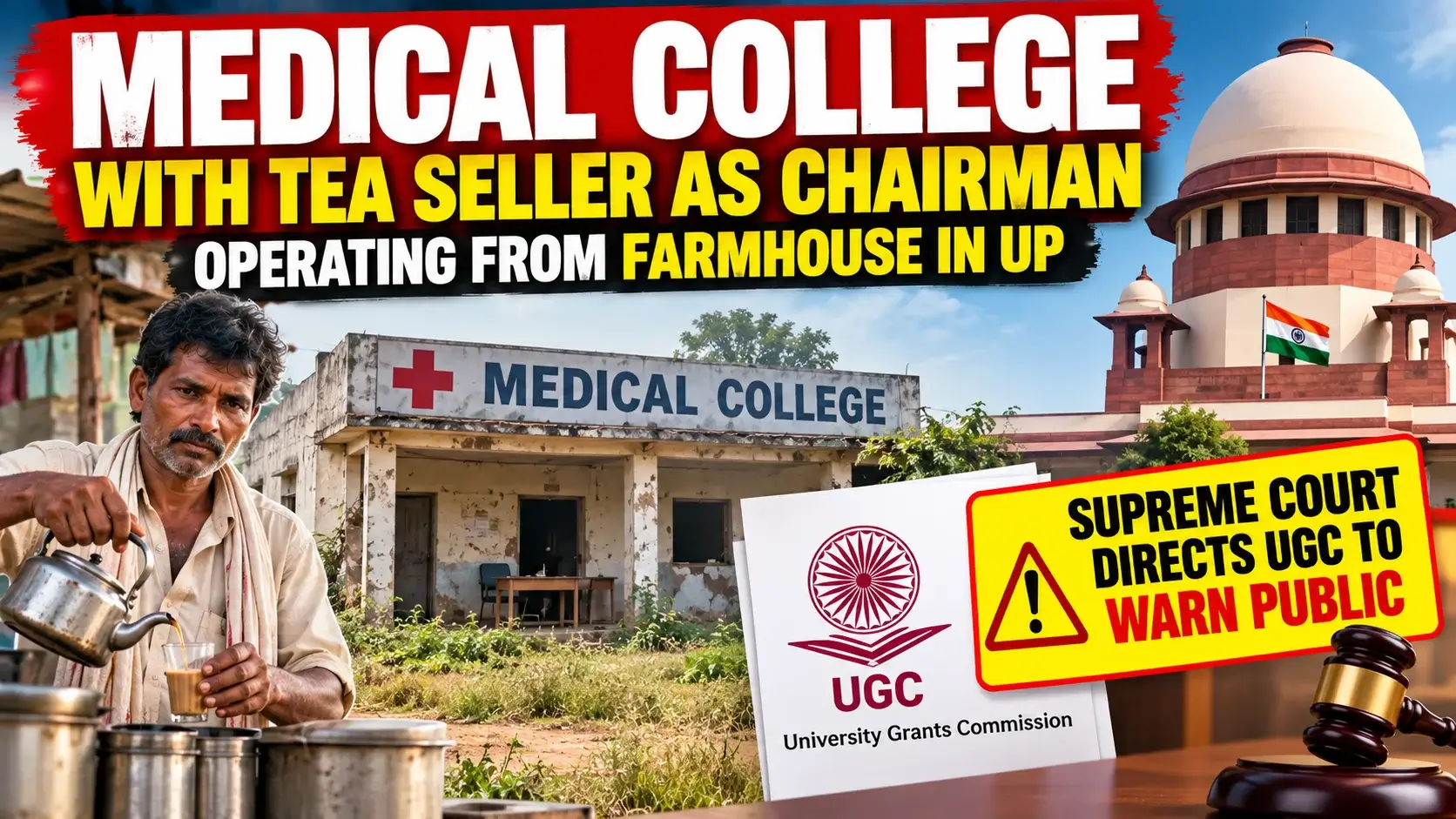
A shocking case involving an alleged fake medical college in Uttar Pradesh has raised serious concerns about educational fraud and student safety. The Supreme Court of India has directed the University Grants Commission (UGC) and other regulatory authorities to issue public advisories warning students and parents against taking admission in institutions without verifying their authenticity.
According to media reports, the alleged institution was operating from a poorly maintained farmhouse in Mahmoodpur Nagaria village, Etah district, Uttar Pradesh. The case highlights the importance of checking a college’s recognition and approval before paying admission fees.
What Happened in the UP Fake Medical College Case?
Reports stated that the purported institution operated from a small, dilapidated building with only two or three rooms in a field. It allegedly advertised several medical, pharmacy, nursing, and paramedical courses.
These reportedly included:
- D.Pharma and B.Pharma
- B.Sc. Nursing
- DMLT and BMLT
- BAMS
- GNM and ANM
One of the most surprising details was that the person listed as chairman was Bhagwan Das Singh Baghel, described in media reports as an illiterate tea seller.
He reportedly told investigators that he was unaware of the institution’s activities and routinely signed documents provided by a person identified as Satender Kumar, who was allegedly running the establishment.
These are reported allegations, and the responsibility of the individuals involved must be determined through the appropriate investigation and legal proceedings.
⚖️ What Did the Supreme Court Say?
A bench comprising Justices Ahsanuddin Amanullah and N.V. Anjaria reportedly took note of the matter during proceedings concerning the regulation of educational institutions.
Following a suggestion from Additional Solicitor General K.M. Nataraj, the Court directed the UGC and other relevant regulatory authorities to issue public advisories warning people against dealing with or taking admission in institutions without verifying their authenticity.
The Union Government was also directed to monitor compliance with these directions.
According to media reports, Uttar Pradesh authorities had initiated police action against people allegedly connected with the institution and ordered an inquiry.
🔍 Why Is This Case Important for Students?
Thousands of students invest significant time, money, and effort in pursuing medical and professional education. Admission to an unrecognised institution can put their fees, academic records, and future career opportunities at risk.
A college advertising a course does not automatically mean it has permission to offer that qualification. Similarly, registration of an organisation does not establish that all its courses are recognised.
Students should independently verify the exact course, institution, affiliation, and applicable regulatory approval before accepting admission.
✅ How to Check Whether a Medical College Is Genuine
Before paying fees, follow these steps:
- MBBS: Verify the institution through the National Medical Commission (NMC).
- Universities: Check the UGC website and its notices about fake universities.
- Pharmacy: Visit the Pharmacy Council of India.
- Nursing: Check the Indian Nursing Council.
- BAMS: Verify applicable recognition and permission requirements with the National Commission for Indian System of Medicine.
Also confirm the awarding university, approved intake, academic session, and official admission procedure. Keep payment receipts and written admission documents.
❓ Frequently Asked Questions
1. Where was the alleged fake medical college located?
It was reportedly located in Mahmoodpur Nagaria village in Etah district, Uttar Pradesh.
2. Why did the Supreme Court direct the UGC to issue warnings?
The Court reportedly wanted students and parents to verify educational institutions before taking admission or dealing with them.
3. How can students check whether a college is recognised?
Check the relevant regulator’s official website and verify the exact course, institution, and academic session.
4. Are all private medical colleges fake?
No. This case concerns allegations against a particular institution. Every college should be assessed using official recognition and approval records.
📰 Conclusion
The alleged UP fake medical college case is a serious reminder that students must verify an institution before taking admission. The Supreme Court’s reported directions to the UGC and other regulators aim to improve public awareness and help prevent educational fraud.
Remember: Verify the college, check course approval, and confirm the awarding university before paying fees.
For more NEET updates, education news, and admission guidance, visit Kota-Notes.com.